
Hello! It's been a minute. I'm super excited to share that I've launched DIYFi Advisors. I help you build simple investment systems that manage themselves—so you never have to pay an advisor (robo- or human) ongoing fees. More on this at the end!
Over the next few months, I'll be breaking down components of diversified portfolios—stocks, bonds, cash, gold, real estate, and even Bitcoin. The goal is simple:
- Understand what each asset is or does
- Think through why it might belong in your portfolio (or not)
- How to implement it without overthinking
Let's start with the foundation: stocks.
What is stock?
When you buy stock, you "own" a piece of a company (which is why it's also called equity). But what does that actually mean?
You own a slice of everything that company will ever earn.
Take Apple (🍎, AAPL).
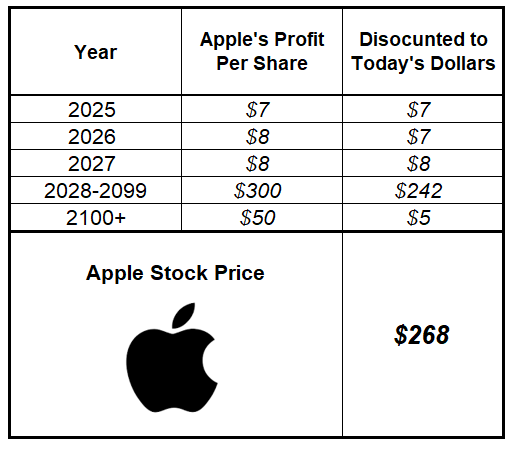
If it earns $100 billion this year, $110 billion next year, and keeps growing, owning Apple stock means you own a tiny fraction of all those profits—not just in 2025, but forever. Stock prices reflect what investors think all those future earnings are worth in today's dollars for every share the company has outstanding.1
That's why Apple trades at $268 per share: it's the market's best guess at what decades of iPhone sales, App Store revenue, and future products are worth right now.
So do stocks only go up?
Theoretically, yes (over a long period of time). And here's why:
- Humans are remarkable innovators. A century ago, it took weeks to send a message across the ocean—today, we can hop on a plane and be in London in less than six hours. That same spirit of innovation makes businesses more efficient and productive over time. As costs fall and output rises, company profits—and therefore stock prices—tend to grow in the long run.
- Populations grow. Demographic shifts in "developed" economies would make you think otherwise, but the global population is still expanding—more people means more demand, more consumption, more growth.
- Markets evolve. Capital flows away from failing companies and toward those creating real value. Over time, the economy naturally reallocates resources to its most productive uses—so investors, in aggregate, stay aligned with progress.
The catch? This plays out over decades, not months. Short-term, anything is fair game. But zoom out 20 years, and the trend is remarkably consistent.
This long-term growth, known as the "equity risk premium", is what makes stocks remarkable and why investors flock to them in the first place.
Here's the concept in a nutshell: historically, the global stock market has returned about 5% after inflation—this is because stocks, or companies' future cash flows, inherently have risk to them, and that 5% is considered your compensation.
The math is compelling: invest $10,000 into the global stock market for 30 years, and you can expect $43,219 after inflation.
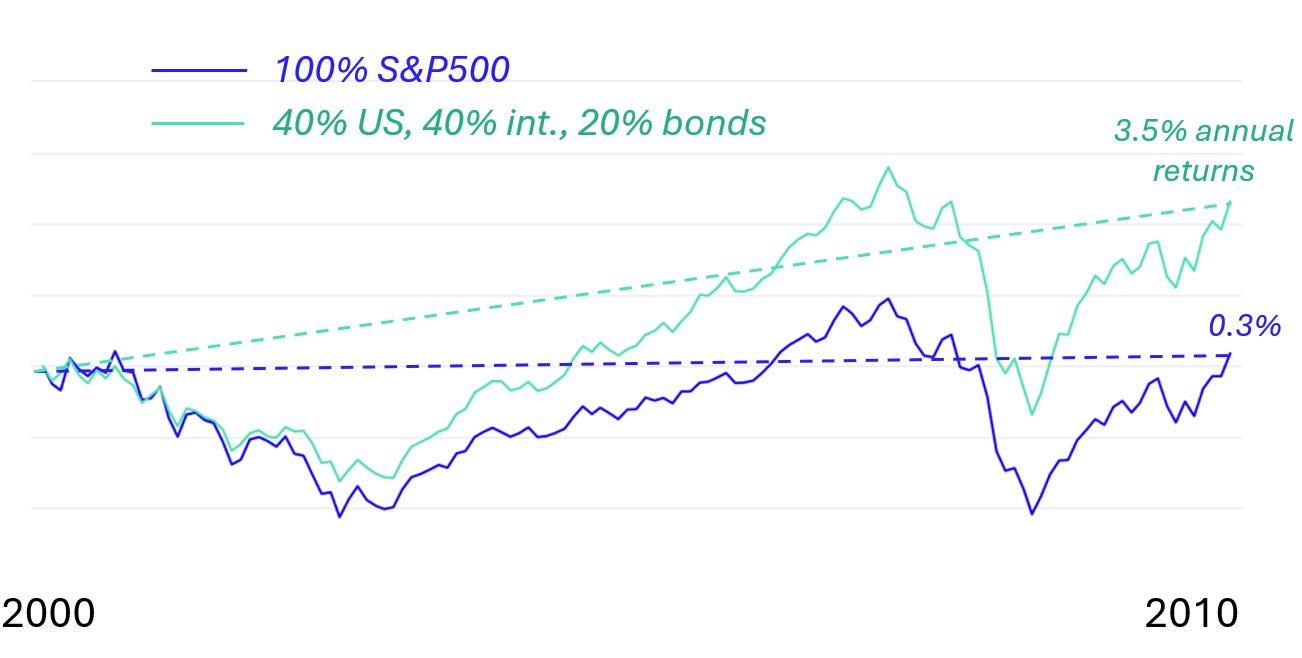
This is, however, a long-term average and not a guarantee. Some decades are much better than 5% (like now), some are much worse. The 2000s were brutal for US stocks, in what's now known as a "lost decade."2
In essence, volatility is the price you pay for that 5%. Stocks can swing wildly in the short term: a 30% drop in a single year isn't unusual, and we've had major crashes as recently as this past April. Most investors know this intellectually, but experiencing a $300,000 portfolio drop to $210,000 tests human psychology.
But history has shown that patient, diversified investors can pretty easily capture the equity risk premium. The key to capturing it is staying invested through those downturns.
And the way to stay invested? Diversification. It smooths out the ride.
Here's a simple example:
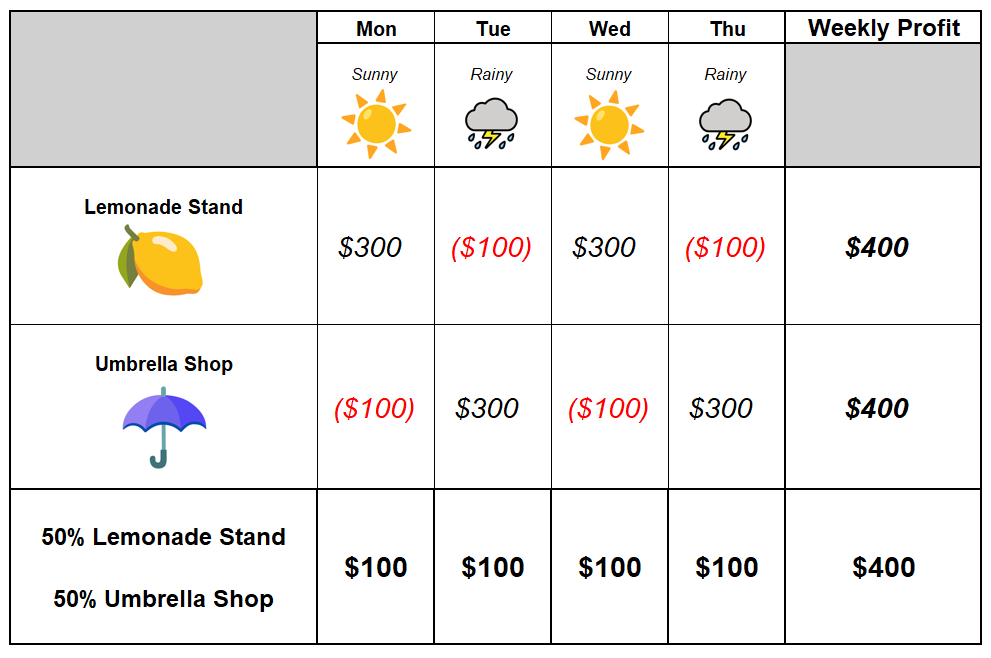
Imagine a small town with two businesses, a lemonade stand and an umbrella shop, and a four-day workweek.
When it's sunny, the lemonade stand does great—but on rainy days, sales drop sharply. The umbrella shop is the opposite story: rain brings big profits, while sunshine hurts business.
If you owned only one of these, your profits would swing up and down with the weather. But if you owned both, your returns would smooth out. When one struggles, the other picks up the slack.
The average weekly profit is the same, but with far less volatility—and far less stress. And when you have far less volatility and far less stress, planning is significantly easier.
Now scale this idea up. Instead of two shops, think thousands of companies across different sectors—tech, healthcare, energy, consumer staples.
Across countries—U.S., Europe, emerging markets.
Across company sizes—from massive global firms to small, innovative startups.
And for a later post, across asset classes—bonds, cash, real estate.
The result? You're no longer betting on a single company, industry, or country. You're capturing broad economic growth while dramatically reducing the risk that any one piece of your portfolio fails.
And when your portfolio drops 15% instead of 30%, you're much more likely to stay the course—and actually earn those long-term market returns.
And here's the most remarkable part: investing and diversifying across all stocks in the world is extremely accessible and straightforward in 2025. Capturing the equity risk premium, with a dash of patience and discipline mixed in, has never been easier.
In the 1990s and early 2000s, you'd pay $10-25 per trade. You'd call a broker to place orders. Many firms had minimum account balances. Real-time quotes cost extra.
Before broad market index funds existed—we're talking the 1970s and 80s—diversification meant hiring a financial advisor to hand-pick 20-30 stocks for you. Those advisors typically charged 1-2% of assets under management annually. On the same $10,000 portfolio I mentioned earlier, you'd end up with $24,000 in 30 years instead—losing over $14,000 in fees alone. No longer.
Today? Commission-free trading at Fidelity, Vanguard, and Schwab. You can trade from your phone instantly. No minimums.
This level of accessibility is remarkable and unprecedented in the history of investing. You can build a globally diversified portfolio in 60 seconds from your phone for virtually nothing.
So do stocks belong in your portfolio? With little doubt in my mind, yes.
Implementation
The implementation is surprisingly simple: buy a globally diversified index fund. One to three funds depending on your brokerage, and you can replicate the global stock market. Done.
You'll own thousands of companies across every sector, every country, every size. US tech giants. European industrials. Japanese manufacturers. Emerging market consumer companies. All of it.
Set dividends to reinvest automatically. Rebalance once a year if your allocation drifts. Don't check it daily.
The hardest part isn't the implementation—it's staying the course when markets drop 30%. That's where diversification helps. And that's why we'll talk about bonds next time.
Want to go deeper? I've built out DIYFi's resource page as a comprehensive guide to constructing a globally diversified portfolio—everything from account selection to fund comparisons to tax-efficient strategies. It's free, and it's designed to be the guide I wish existed when I started investing.
Next time: Bonds—why they're not just for retirees, and how they protect your portfolio when stocks stumble.
I've officially launched DIYFi Advisors. I help you set up a personal finance system and investment strategy that doesn't require ongoing management—so you never have to pay a financial advisor again.
We work together for an upfront fee. I'll help you cut through the noise, set everything up properly, and then the system we implement manages itself. No ongoing charges, no percentage of your assets.
If you're interested in working together, schedule a free consultation. This newsletter will continue to provide free, practical financial guidance whether you work with me or not.
Thanks for being here.
— Rutvik
1 Financial economists call this the "discounted value" of expected future cash flows—though in real markets, prices also reflect things like sentiment, liquidity, and trading dynamics.
2 However, globally-diversified portfolios with bonds still saw positive returns after inflation.